
MCP-CE 2014: Vorläufiges Konferenzprogramm

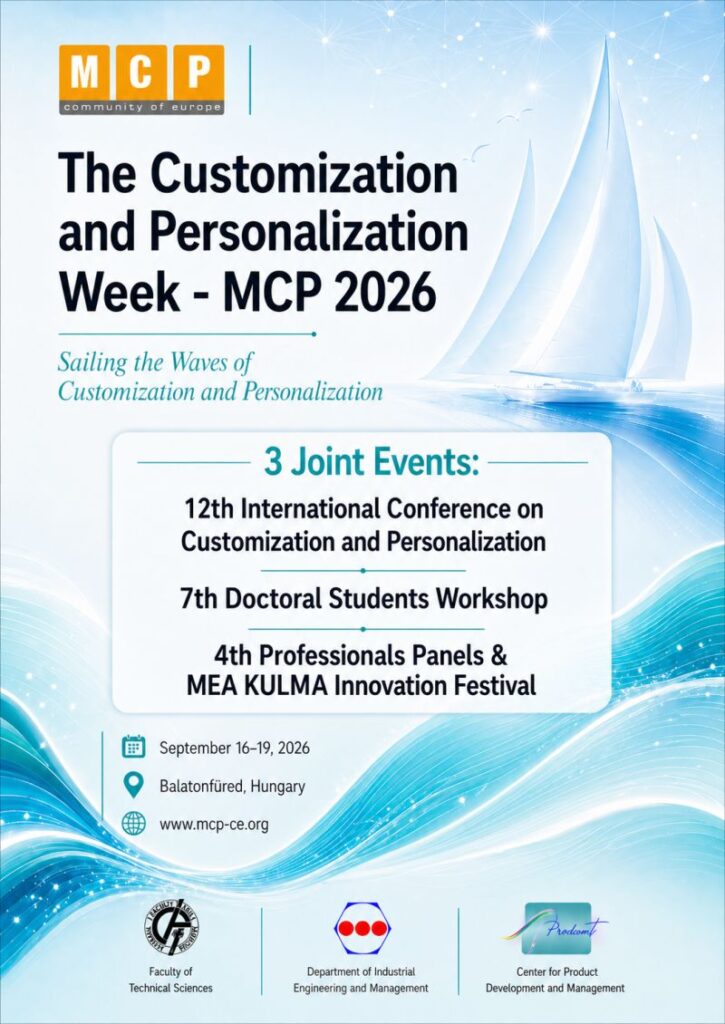
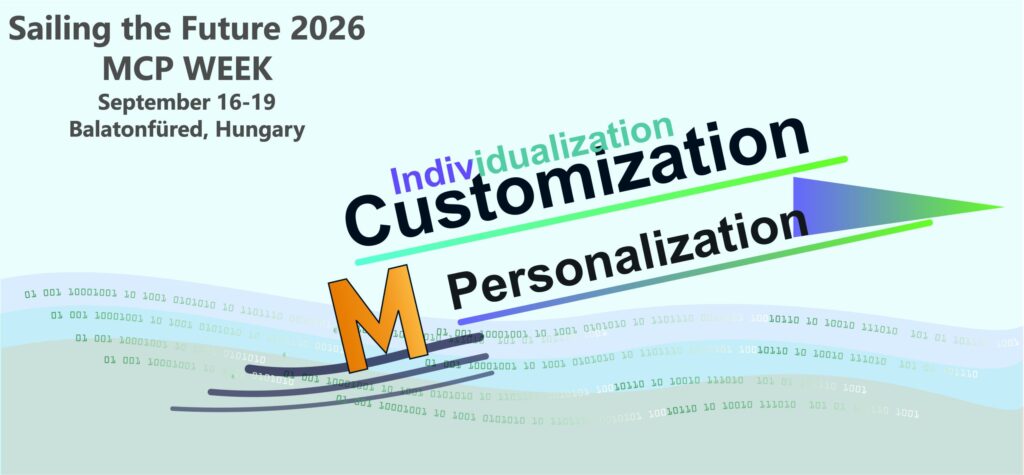
preliminary_programme_mcp_ce_2014Vom 23.-26.09.2014 findet die 6. MCP-CE an der Universität Novi Sad mit ihren ca. 38.000 Studenten statt. Das vorläufige Konferenzprogramm zeigt, dass es sich lohnt, an der Konferenz teilzunehmen. Der erste Tag steht ganz im Zeichen des Doktoranden-Workshops, den wir im Rahmen der Konfernzreihe zum ersten Mal durchführen werden. Am zweiten und dritten Tag werden die verschiedenen Paper präsentiert. Am Vormittag werden die Beiträge wie bisher vorgestellt. Am Nachmittag haben wir diesmal neu eine Poster Session eingeplant, wodurch etwas Bewegung in die Konferenz gebracht wird. Das beliebte Konferenz-Dinner schließt den dritten Tag ab. Am vierten Tag haben wir am Vormittag noch die Vorstellung einiger Paper eingeplant und für den Nachmittag eine Exkursion in die tolle Landschaft der Vojvodina vorgesehen. Insgesamt ist es für den 10. Geburtstag der Konferenzreihe ein würdiges Programm. Siehe dazu auch Konferenzen und Veröffentlichungen.

Orcik, A.; Stojanova, T.; Freund, R. (2013): Co-Creation: Examples and Lessons Learned from South-East Europe

Das Paper Orcik, A.; Stojanova, T.; Freund, R. (2013): Co-Creation: Examples and Lessons Learned from South-East Europe wurde im Double-Blind Review Process für die Konferenz ICEIRD 2013 akzeptiert. Die Konferenz wird vom 20.-21.06.2013 in Istanbul/Türkei stattfinden. Abstract: „The purpose of this paper is to show examples of customer co-creation used by companies from South-East Europe (SEE) and define their most important characteristics. They are compared with the world’s best practices through the framework that integrates four dimensions: customers’ motives for co-creation, stage of product life cycle in which co-creation is initiated, co-creation types and platforms used for co-creation initiatives. The case study approach is used to reveal insights about the state-of-the-art in customer co-creation in SEE. The research includes studies of web-based content related to co-creation. The exploratory nature of the research means that the findings are tentative and need to be confirmed by quantitative large-scale studies. The overview of co-creation initiatives from SEE is given by highlighting the potential co-creation offers to SMEs and large enterprises. Although customer co-creation is known approach in the world, it is not commonly used by companies from the region. This study makes an original contribution by presenting lessons learned from examples of best co-creation practices in SEE. The results of the study provide management with guidelines for successful co-creation projects with an innovation- and market-oriented approach.“ Siehe dazu auch ICEIRD 2011 und ICEIRD 2012 und Veröffentlichungen.

Wie kann eine Organisation auf den Trend zu User Innovation ausgerichtet werden?

Klassische Innovationsprozesse (Closed Innovation) laufen in traditionellen Strukturen der Aufbau- und Ablauforganisation ab – daran haben wir uns gewöhnt. Die Entgrenzung des Innovationsprozesses führt immer mehr zur Öffnung des Innovationsprozesses (Open Innovation) und damit auch zu veränderten Anforderungen an Organisationen. Diese Herausforderungen sind für Unternehmen heute schon in immer mehr Bereichen zu erkennen – doch das ist noch nicht alles, denn es geht noch weiter. Der eigentliche Push liegt darin, User Innovation (Democratizing Innovation) organisational zu strukturieren. Doch wie kann sich eine Organisation auf User Innovation einstellen? Der sehr lesenswerte Artikel Keinz, P.; Hienerth, C.; Lettl, C. (2012): Designing the Organization for User Innovation. In: Journal of Organization Design JOD, 1(3): 20-36 geht genau dieser Frage sehr umfassend nach (Abstract):  „There is increasing consensus among practitioners and academics alike that we are in the midst of a paradigm shift from producer-centered and internal innovation processes toward user-centered and open innovation processes. This paradigm shift induces significant changes to the design of organizations. Even though the research field of user innovation has been developing over a period of more than four decades, there have been only occasional intersections with the research field of organizational design. In this article, we aim to provide an integrated perspective of the two fields. We first identify major user innovation strategies. We then derive the implications for each user innovation strategy on key dimensions of organizational design.“ Auf diesen Artikel bin ich in dem Blogbeitrag von Frank Piller aufmerksam geworden – Danke. Siehe dazu auch Open Innovation oder doch besser Innovation Openess?, Customer Co-Creation and Social Embededness, Freund, R. (2012): Co-Creation and Bottom-Up Economy.

Lukac, D.; Freund, R. (2012): Open Innovation, Social Embeddedness of Economic Action and its Cultural Determinants

Gemeinsam mit Herrn Dr. Dusko Lukac von der Rheinischen Fachhochschule in Köln habe ich ein Paper zur MCP-CE 2012 geschrieben, das wir im September auf der Konferenz vorstellen werden:

Lukac, D.; Freund, R. (2012): Open Innovation, Social Embeddedness of Economic Action and its Cultural Determinants

Abstract: The paper concerns the position of the economy within a socio-theoretical conception as a part of the new economic sociology, in the context of its influence of the economic action, especially in the macroeconomic view. Based on secondary research we review and challenge the primacy of economy in the contemporary society and we focus on the cultural determinantes for social embeddedness.

Siehe dazu auch Veröffentlichungen.

Freund/Anisic/Rither/Jovanovic (2012): Customer Co-Creation and New Economic Sociology

Im letzten Jahr habe ich an der ICEIRD 2011 teilgenommen und ein Paper präsentiert. Auch in diesem Jahr habe ich gemeinsam mit meinen Kollegen ein Paper zur ICEIRD 2012 (Agenda) eingereicht, das auf der Konferenz präsentiert wird.

Freund/Anisic/Rither/Jovanovic (2012): Co-Creation and New Economic Sociology

Abstract: Customer co-creation entails the active involvement of customers in the innovation activities of the firm. This collaborative production is a new kind of collective action that is socially embedded in internet communities and includes self-selected individual action as part of collective self-organization. The specifics of this social embeddedness have received less attention in the debate. In this paper we argue, that the sociological perspective should applied to economic phenomena like customer co-creation and that SME can benefit from this perspective.

Siehe dazu auch MCPC 2011, MCP-CE 2012 und Veröffentlichungen.

MCPC 2011 in San Francisco: Mein Paper „Management of Uncertainty: The Key for Open Innovation“ wurde akzeptiert

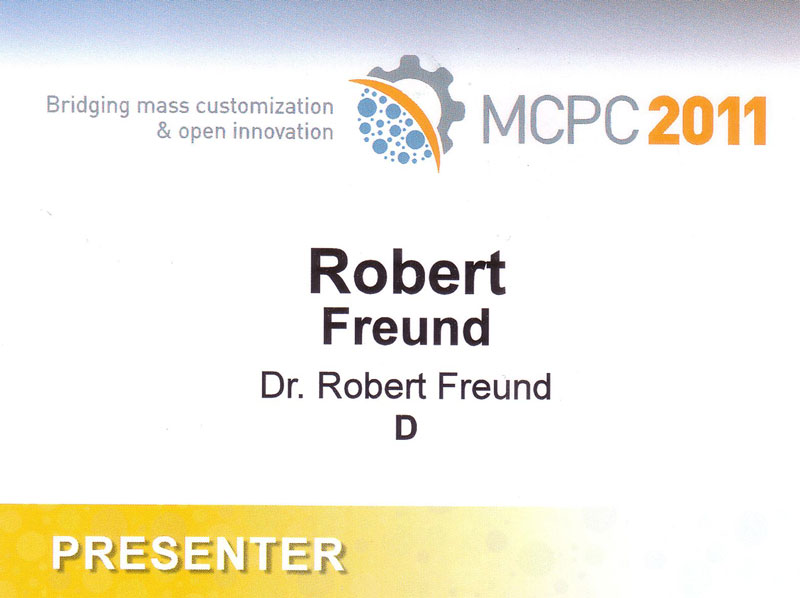
Heute habe ich die Bestätigung erhalten, dass mein Paper für die 2011 Worldconference in Mass Customization, Personalization and Co-Creation (MCPC 2011) akzeptiert wurde. Die Konferenz findet vom 15.-19. November 2011 in San Francisco (Airport Marriott Waterfront) statt:

Dear Dr. Robert Freund:

Congratulations, your submission „Management of Uncertainty: The key for Open Innovation“ has been accepted for presentation at the MCPC 2011.

Es freut mich sehr, dass ich nach 2001 (Hong Kong: HKUST), 2003 (TU München), 2005 (Hong Kong:HKUST), 2007 (MIT, USA), 2009 (Helsinki, Finnland) nun auch in San Francisco einen Vortrag halten kann (Siehe dazu auch Veröffentlichungen oder Konferenzen) In meinem Paper habe ich die beiden mich stark interessierenden Themen Uncertainty und Open Innovation zusammengebracht und versucht, eine Möglichkeit zur Bewältigung von Unsicherheit/Unbestimmtheit in offenen Innovationsprozessen aufzuzeigen. Ich bin jetzt schon gespannt auf die Reaktionen auf meine Arbeit und auf die spannenden Diskussionen mit Teilnehmern aus aller Welt.

Paper zur World Conference on Mass Customization, Personalization, and Co-Creation (MCPC 2011) in San Francisco eingereicht

Pünklich zur Deadline am 07.05.2011 habe ich ein Paper zu Open Innovation für die nächste MCPC 2011 (World Conference on Mass Customization, Personalization and Co-Creation) eingereicht, die vom 15-19.11.2011 in San Francisco (USA) stattfinden wird. Da ich an allen bisherigen Weltkonferenzen teilgenommen und Vorträge gehalten habe (Veröffentlichungen), rechne ich mir auch dieses Mal Chancen aus, dass mein Paper angenommen wird. Ende Juni werde ich wissen, ob es geklappt hat. Diesmal befasst sich die Konferenz mit den Zusammenhängen von Mass Customization und Open Innovation. Es ist deutlich zu bemerken, dass sich die Unternehmen, die sich zunächst an Mass Customization orientiert haben, sich in Richtung Open Innovation weiterentwickeln. Mein eingereichtes Paper ist als Diskussionsbeitrag zu Open Innovation einzuordnen.

Freund, R. (2010): Open Innovation, Open Evaluation and Crowdfunding

Für die MCP-CE 2010 habe ich ein Paper zu Open Innovation, Open Evaluation and Crowdfunding geschrieben (Veröffentlichungen). Die Öffnung des Innovationsprozesses (Open Innovation) führt mit Hilfe von modernen IT-basierten (Online-) Ideenwettbewerben zu sehr vielen Ideen, die auch von Externen bewertet werden sollten (Open Evaluation, Möslein et al. 2010). Darüber hinaus plädiere ich dafür, diesen Bewertungsprozess abhängig zu machen von kulturellen Aspekten (Kontext, Bullinger et al. 2009). Last but not least gehe ich auf die verschiedenen Möglichkeiten ein, Crowdfunding für die Finanzierung von Projektideen einzusetzen. Open Innovation, Open Evaluation und Crowdfunding sind aus meiner Perspektive sehr gute Möglichkeiten, die Grenzen zwischen Economy und Sociology zu überwinden und somit die Entwicklung zu einer Economic Sociology  zu unterstützen: Follow the interest! (Swedberg 2003). Sollten Sie an dem Paper interessiert sein, so melden Sie sich doch einfach bei mir.

Mass Customization in Osteuropa: Veröffentlichung eines gemeinsamen Papers in einer rumänischen Fachzeitschrift

Das Paper Anisic/Tudjarov/Tsigkas/ Chatzopulous/Freund (2009): Some results of mapping of Mass Customization activities in SE Europe, ist in der rumänischen Fachzeitschrift Journal of Engineering, Vol VII, S. 151-156, erschienen. Diese gemeinsame Veröffentlichung geht zurück auf eine Präsentation, die im Rahmen der ICEIRD 2009 im April in Thessaloniki gehalten wurde:


 Abstract: The paper presents results of mapping different activities and subjects in the field of mass customization and personalization (MCP) in Central and Southeast Europe. The results of mapping are presented in Google Maps, devided into four main groups: research institutions, companies, national websites and dedicated conferences. The map is open to everyone, accessible through the Internet, displaying information about the relevant people and institutions. It can be concluded that mass customization business model was first adapted by national universities and then successfully transferred to SME`s and entrepreneurs. The aim is to set up a network of knowledge to help researchers and companies to implement their ideas smoothly